
When God Goes Quiet
You've prayed it at the same red light every morning for months. Maybe it's about the job that keeps not opening up, or the son who stopped returning your calls, or a marriage that has gone quiet in a way neither of you knows how to name. You say the words. You wait. The light turns green, and you drive on.
Nothing comes back. No verse jumps off the page during your morning reading. The worship songs that used to undo you on Sunday now sound like songs. You keep showing up, and the room keeps feeling empty.
If that's where you are, I won't tell you it's all in your head. The quiet is real. People who loved God deeply have lived inside it for long stretches, and whole psalms were written from there.
The Quiet Feels Like a Verdict
Part of what makes God's silence so hard is that most of us have been taught to read it as a judgment. If God isn't speaking, we assume we did something to shut him up. So we pray longer. We confess things we've already confessed. We scan the last few months for the sin that must explain this.
Or we go the other direction and quietly decide that whatever we used to feel was never really him.
Both readings make the silence about us: either we caused it, or we imagined everything before it. There's a third way to read it, and it's hidden in one of the most overlooked verses in the Old Testament.
The Quarry Under the City
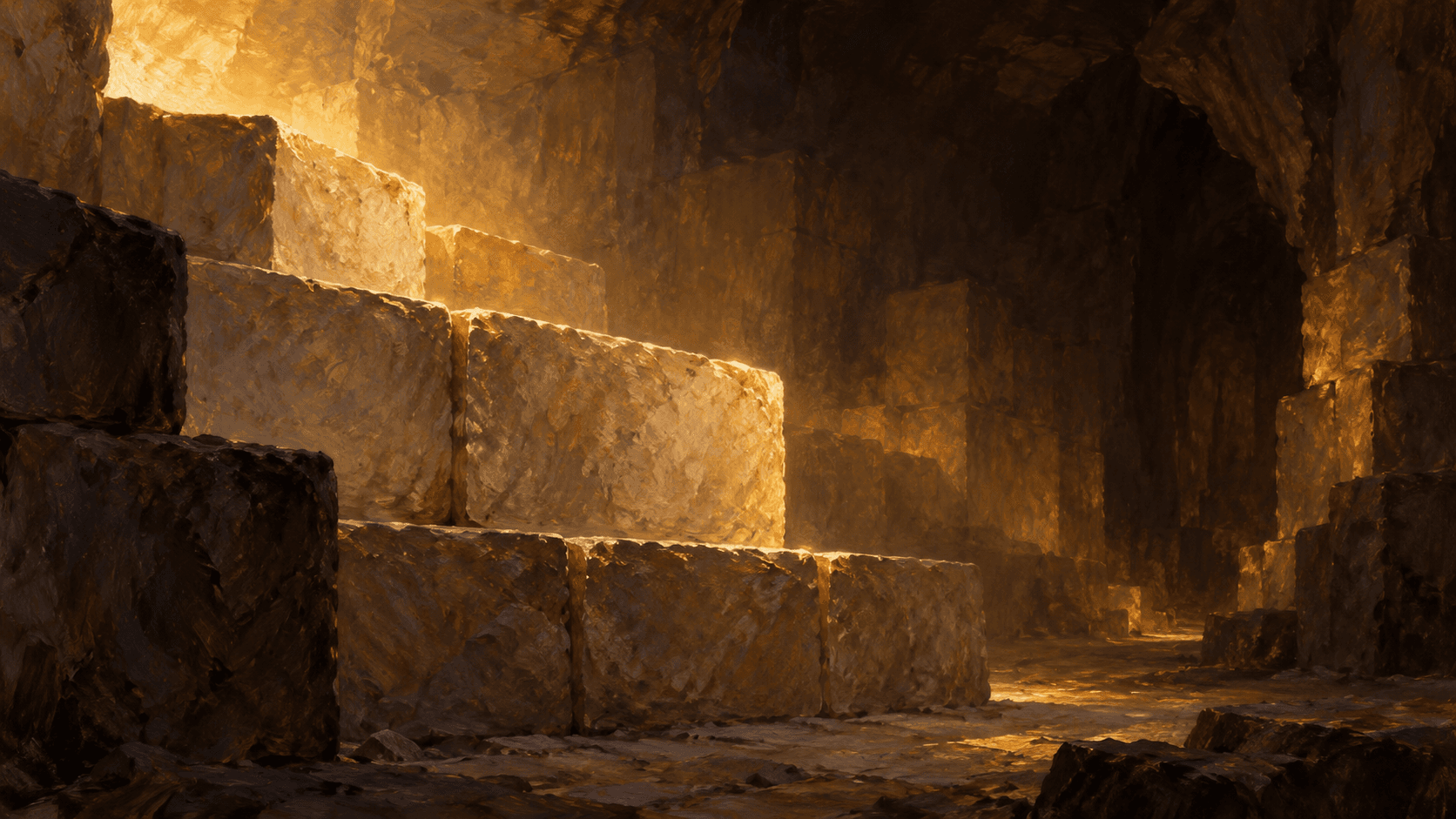
When Solomon built the temple in Jerusalem, the construction site was strangely quiet.
In building the temple, only blocks dressed at the quarry were used, and no hammer, chisel or any other iron tool was heard at the temple site while it was being built. (1 Kings 6:7, NIV)
Picture what that means. Enormous blocks of limestone were cut, squared, and smoothed somewhere else. By the time a stone arrived at the temple, it was ready. It was lifted into place and set against its neighbors, and the people standing on the site never heard it being made.
The noise was real. Somewhere chisels were ringing, dust hung in the air, and workers spent months bent over rock. It just wasn't happening where the onlookers were standing. An old tradition even points to a vast quarry carved out beneath Jerusalem itself, with the city going about its business directly above the place where the temple's stones were being shaped.
If you had stood at the temple site and listened, you might have concluded nothing was happening. You'd have been right about the sound and wrong about the work.
Some of what God does in a person happens at the quarry. Patience that has no audience. The ability to keep loving someone who doesn't love you back the way you hoped. Honesty you practice alone, in a room where nobody would ever know the difference. None of that gets built on a stage. It gets shaped where no one is watching, often in the very seasons when you feel the least.
The Same Hands, Start to Finish
Anyone who has managed a building project knows a particular kind of headache. The architect draws one thing. The builder, working with real dimensions and real materials, can't make it work. The two argue, the plans get revised, and sometimes someone gets fired. The trouble usually comes from two different minds holding two different versions of the plan.
That trouble disappears when the one who drew the plans is also the one doing the building.
Paul made this promise to a church he loved:
He who began a good work in you will carry it on to completion until the day of Christ Jesus. (Philippians 1:6, NIV)
Whoever started the work in you is the one finishing it. He isn't passing your blueprint to a contractor who might misread it, and he isn't passing it to you.
"The architect and the builder are the same person, and neither of them is you."
That's hard news if you were hoping to speed things up. It's very good news if you're tired. A stone doesn't need to know what it's being shaped for. It only needs to stay at the quarry.
What You Do at the Quarry
So what does a stone do with a silent season?
Most of the advice we get about God's silence is a list of efforts: pray more, praise anyway, push through. Those things can be good. When they become strategies for getting God to speak again, though, they turn the quiet into a test you're trying to pass.
The Hebrew word hagah, often translated "meditate," describes something slower. It's the low murmur of someone turning a few words over and over, the way you might hum a line of a song without thinking about it. It fills the quiet with something true and lets it stay there.
In a silent season, that might mean taking one sentence (he who began a good work in you will carry it on to completion) and saying it slowly, in time with your breath, until it feels less like information and more like company. You don't have to feel anything for it to matter. A stone doesn't experience the chisel as progress.
That kind of minute is what we made Relm to hold: one line of Scripture, a few slow breaths, and nothing to perform.
When the Quiet Is Something Heavier
One honest word here. Sometimes a long stretch where God feels far away is also depression, or grief that hasn't found its way out, or exhaustion that has settled into your body. Those can sit right alongside a real spiritual season and feel identical from the inside.
If the quiet has started to look like not wanting to get out of bed, losing interest in people you love, or a heaviness that won't lift, please talk to a doctor or a counselor. Getting that help is part of being honest about where you are, and God does his work through good doctors and counselors too.
Your Next Step
This week, pick one quiet moment you already have: the red light, the shower, the first minute after you sit down in the car. Instead of reaching for the prayer you've worn smooth, try this:
Lord, I can't hear you right now. I'm trusting that you're still working where I can't see. Finish what you started in me.
Then let the silence be silence. You don't have to fill it, and you don't have to interpret it.
Every stone cut at that quarry made it to the temple, set in the exact place it was shaped to fit. The quiet you're in now is part of the building, and the building isn't finished yet.
If you'd like a quiet place to return to while you wait, we'd love to have you in Relm: slow minutes with Scripture for the seasons when God seems far away.
👉 [Find Relm here]
Welcome home.
Live this in the app
Try Relm free — daily devotionals, guided meditations, and a prayer journal that grows with you.
More in Prayer

Keep this kind of reflection coming
Subscribe to The Relm Journal — one weekly note, faith-led, never noisy.